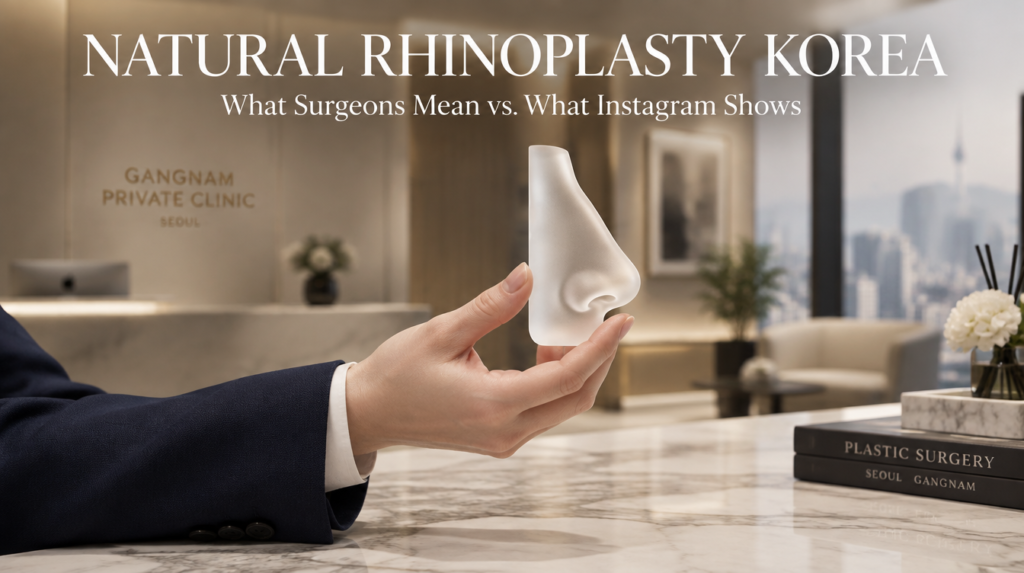
Natural rhinoplasty Korea is one of the most-searched phrases among foreign patients planning a trip to Seoul — and also one of the most misunderstood.
Everyone arrives with the same reference folder: a saved Instagram carousel, a celebrity’s profile shot, a “my nose job results” Reel filmed in perfect light. The photo looks effortless, like the nose was simply always that way. That’s exactly the look most people mean when they ask for natural rhinoplasty in Korea.
The problem is that the photo and the surgery are two different objects. One is a two-dimensional image, chosen from dozens of takes, under one angle of light. The other is a living structure of bone, cartilage, and skin that has to move, breathe, and age with the rest of your face. Closing that gap — honestly — is what this article is for.
What “Natural Rhinoplasty” Actually Means in Korea
Ask five surgeons to define natural rhinoplasty Korea style, and you’ll get five versions of the same idea: refinement, not reinvention. The goal isn’t a different nose — it’s your nose, with its structural problems corrected and its proportions brought into balance with your eyes, lips, and jawline (Dr. Philip Miller).
In practice, that philosophy shows up in two technical choices Korean clinics are known for.
Preservation and structural techniques. Instead of aggressively breaking down the nasal bones, many surgeons now favor controlled, conservative adjustments that keep the nose’s natural movement and “character” intact — part of why a well-done natural rhinoplasty can be hard for even a trained eye to spot in person.
Autologous cartilage over synthetic implants. For patients who need real structural support — common in ethnic and revision rhinoplasty — Korean surgeons frequently use the patient’s own rib, ear, or septal cartilage rather than silicone implants. Cartilage integrates with your tissue and moves naturally over decades; a stiff implant can migrate, thin the overlying skin, or look visibly “done” as it ages (Kowon Plastic Surgery).
Neither of these is a brand name or a marketing package — they’re structural decisions made in person, based on your actual cartilage, skin thickness, and bone structure. Which is exactly where the Instagram photo stops being useful.
The Instagram Gap: Curated Photos vs. Real Anatomy
A reference photo is already the end of a long filtering process, even before any edits: one angle out of dozens, one lighting setup, one chosen moment months after swelling fully resolved. It tells you almost nothing about the person’s original bone structure, skin thickness, or how long it actually took to get there.
Surgeons who specialize in natural rhinoplasty Korea cases are blunt about this gap: no two noses, and no two faces, are the same, and a result copied from someone else’s anatomy onto yours tends to look exactly like what it is — borrowed, not natural.
Instagram Expectation vs. Surgical Reality
| What the Photo Shows | What Actually Determines It |
|---|---|
| A thin, perfectly straight bridge | Your own bone width and skin thickness — thick skin cannot show fine bone detail no matter the technique |
| Results visible immediately | Final shape typically settles over several months to about a year as swelling resolves |
| One flattering angle | A full structural assessment: profile, frontal, base, and how the nose moves with expression |
| “Just like this celebrity’s nose” | A structure built from your own cartilage and proportions — not a template applied to a different face |
| No visible scarring or stiffness | Technique choice (preservation vs. structural, autologous cartilage vs. implant) made after physically examining your tissue |
None of this means the look in your reference photo is unreachable — it means the photo is a starting conversation, not a blueprint a surgeon can promise sight-unseen.
Who’s Actually a Good Candidate for Natural Rhinoplasty in Korea
A real consultation for natural rhinoplasty Korea clinics take seriously looks nothing like a quick “yes, we can do that” over a photo. It typically includes:
- A physical exam of your skin thickness, bone width, and existing cartilage — the three factors that decide how subtle or dramatic a change can realistically look
- A conversation about your facial proportions as a whole, not the nose in isolation
- An honest answer about whether preservation technique or more structural work (sometimes with autologous cartilage) fits your anatomy
- A realistic timeline for swelling and final results, not a same-week preview
This is also where a facilitator’s role is worth being precise about: a pre-trip preliminary photo review based on board-certified specialist consultation can help you understand realistic possibilities and plan your trip — but it is never a diagnosis, and the final surgical plan is confirmed only during your in-person consultation with the board-certified surgeon in Seoul.
If you’re also researching the credentials side of this decision, our guide on how to verify a surgeon is actually board-certified walks through the exact steps before you book anything. And if you’re planning recovery time around your trip, our 7-day rhinoplasty recovery routine covers the realistic day-by-day healing timeline.
Guardian’s Insider Note
The red flag I watch for most with natural rhinoplasty Korea inquiries isn’t a scary price — it’s a clinic that says yes to a reference photo before anyone has touched your nose. A surgeon confident in their own judgment will tell you, sometimes gently, that a specific photo isn’t realistic for your skin thickness or bone structure — and offer what actually is. A clinic that promises to “copy” any photo exactly, sight unseen, is optimizing for your booking, not your result. Ask directly: “What about my own anatomy might make this different from the photo?” A thoughtful, specific answer is a good sign. A vague “don’t worry, we’ll make it work” is not.
Realistic Pricing for Natural Rhinoplasty in Gangnam
Pricing for natural rhinoplasty Korea procedures varies significantly by technique, and any number you see online should be read as a realistic average clinic range, not a locked quote:
| Procedure Type | Realistic Average Gangnam Range (USD)* |
|---|---|
| Primary rhinoplasty (preservation/refinement) | ~$3,500 – $8,000 |
| Rhinoplasty with autologous cartilage (rib/ear) | ~$6,000 – $12,000 |
| Revision rhinoplasty | ~$5,000 – $13,000+ |
*Illustrative industry-level ranges only — not a quote for any specific clinic or patient. Final pricing depends on technique, cartilage source, anesthesia, and the board-certified surgeon’s in-person assessment.
A transparent clinic itemizes the procedure fee, anesthesia, facility fee, and aftercare separately, and will tell you plainly if cartilage grafting adds cost before you’re on the table — not after. Eligible foreign visitors may also qualify for a VAT refund on qualifying purchases; confirm current eligibility directly with your clinic, as refund programs can change year to year.
Frequently Asked Questions
- What does “natural rhinoplasty” actually mean? It means refinement rather than reinvention — correcting structural issues and improving proportion while preserving the nose’s natural movement and character, rather than copying a different nose shape onto your face.
- Can I just bring a photo and ask for that exact result? You can bring a photo as a starting reference, but a board-certified surgeon will assess whether it’s realistic for your specific bone structure and skin thickness during an in-person exam — a reputable clinic won’t promise an exact copy sight-unseen.
- Why do Korean surgeons use cartilage instead of implants? For patients needing structural support, autologous (your own) cartilage integrates with your tissue and moves and ages naturally, while synthetic implants can migrate or look visibly rigid over time — though the right choice depends on your individual case.
- How long until I see my final result? Initial swelling typically improves over the first few weeks, but the nose’s true final shape commonly continues settling for several months up to about a year, depending on skin thickness and individual healing.
- Is a pre-trip consultation the same as a diagnosis? No — it’s a preliminary photo review based on a board-certified specialist’s initial read, used for trip planning. Your actual surgical plan and technique are confirmed only in person in Seoul.
- Does natural rhinoplasty cost more than a “standard” nose job? Not necessarily — pricing depends more on technique (preservation vs. structural, cartilage source) than on the word “natural” itself; always ask for an itemized, realistic range.
Plan Your Consultation
- Start here: Send us your reference photos and a few clear images of your own nose for a preliminary photo review based on board-certified specialist consultation.
- What you get: An honest first read on what’s realistic for your anatomy — not a sales pitch built around a photo.
- How to reach us: Message us on WhatsApp or DM to begin a personalized, no-pressure consultation.
- What happens in Seoul: Your final technique, cartilage source, and surgical plan are confirmed only after an in-person consultation with a board-certified surgeon at an accredited Gangnam clinic.
Disclaimer: Medical consultations and procedures are exclusively conducted by board-certified Korean doctors at accredited clinics. Individual outcomes and downtime vary.
Sources
- Expectation vs. Reality in Rhinoplasty — Ward MD
- Can You Get Rhinoplasty Without Losing Your Natural Look? — Dr. Philip Miller
- Autologous Costal Cartilage Rhinoplasty Korea — Kowon Plastic Surgery