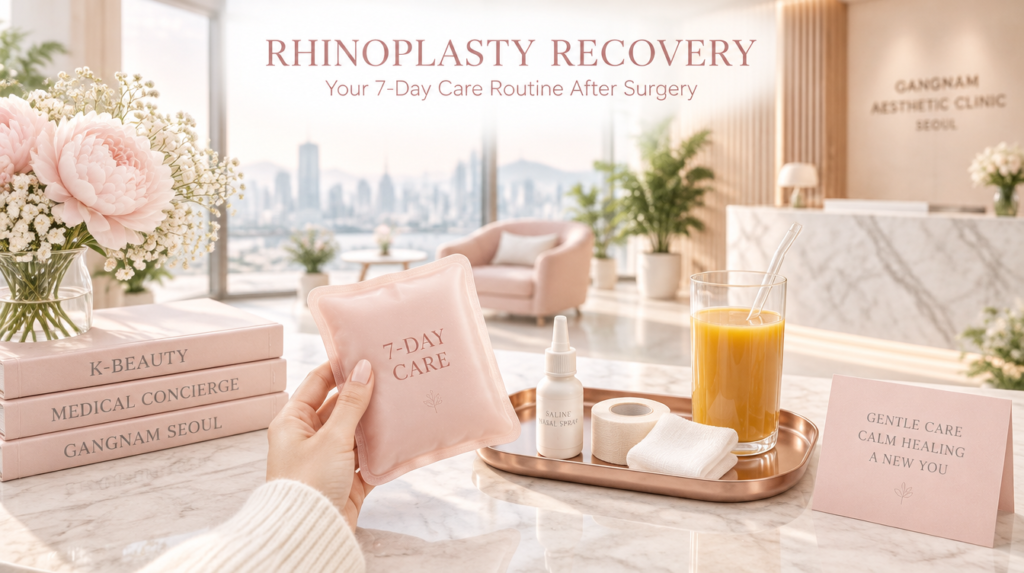
Most people planning a nose job in Seoul spend weeks comparing surgeons and almost no time planning rhinoplasty recovery itself. That’s backwards. The first seven days decide how comfortable you are, how your swelling behaves, and whether your flight home becomes a problem.
Here’s the reassuring part: the first week follows a predictable pattern. Most patients wear tapes and a splint, need prescription pain medication for only a day or two, and have the splint and sutures removed within the first week (American Society of Plastic Surgeons).
This guide walks through that week day by day: what you’ll feel, what to do, what to avoid, and the questions worth asking your surgeon before you leave the clinic. It isn’t medical advice. Your surgeon’s written aftercare sheet always comes first.
What Rhinoplasty Recovery Looks Like in Week One
When you leave the operating room, you’ll usually have a splint and tapes on the outside of your nose. Some patients also have soft packing or internal splints inside. Both are there to protect the new structure while it starts to set (ASPS).
Pain is usually less than people expect. What bothers most patients is pressure and a blocked nose, because swelling makes nasal breathing difficult for several days.
The technique matters too. Open rhinoplasty, with a small incision across the columella, tends to cause more tip swelling than a closed approach. Thicker skin, cartilage grafts and more extensive bone work can also mean a longer rhinoplasty recovery. Many Korean procedures involve augmentation with an implant or cartilage graft, so ask your surgeon exactly what was done.
Rhinoplasty Recovery Is Longer Than One Week
Week one is the most intense part, not the whole story. Initial swelling settles within a few weeks, but your nasal contour can keep refining for up to a year. Swelling may also come and go, and often looks worse in the morning (ASPS).
The tip stays swollen the longest. Roughly half of the swelling is gone by six weeks, while the final result can take a year or more to show.
Your Day-by-Day Rhinoplasty Recovery Routine
Use this as a general map, not a prescription. Clinics differ on timing, especially for washing and splint removal.
Day 0: Surgery Day
- Rest with your head raised above your heart. Use two or three pillows, or sleep in a recliner.
- Expect a small gauze “moustache dressing” under your nose. Change it when it’s saturated, as instructed.
- Breathe through your mouth. Keep water and lip balm next to the bed, because your mouth and throat will dry out fast.
- Have someone with you for the first 24 to 48 hours.
Day 1: Settling In
- Take your prescribed medication on schedule rather than waiting for pain to build.
- Don’t blow your nose. If you need to sneeze, sneeze with your mouth open.
- Wash your face by gently patting around the splint, never over it.
- Stick to soft food that doesn’t need hard chewing or wide mouth movements.
Days 2–3: Peak Swelling
Swelling and bruising usually peak in this window, so keeping your head elevated matters most now (University of Utah Health).
- Use cold compresses only where your clinic tells you to, usually around the eyes and cheeks, not pressing on the nose.
- Take short, slow walks around your hotel room or lobby to keep circulation moving.
- Shower only if your clinic allows it, and keep the splint completely dry.
- Skip alcohol and any medication or supplement your surgeon hasn’t approved. Aspirin, ibuprofen and fish oil can increase bruising.
Days 4–5: Turning the Corner
- Bruising starts shifting from purple to yellow-green. This is normal fading, not a new problem.
- Congestion is still common. Use saline spray only if it was prescribed, and only as directed.
- Most patients feel well enough for a slow café visit. Keep your face out of direct sun.
Day 6: The Day Before Splint Removal
- Confirm your appointment time and how you’re getting to the clinic.
- Write down your questions: glasses, exercise, flying, makeup, and follow-up by message once you’re home.
Day 7: Rhinoplasty Splint Removal
The splint and any non-dissolving sutures usually come off around one week, and under-eye bruising is mostly resolved by then (ASPS). Some surgeons re-tape the nose for a few more days.
Your nose will look swollen, especially at the tip, and may look slightly uneven. That’s expected at this stage. Judge the result months from now, not in the clinic mirror.
What Comes After Day 7
- Glasses: many surgeons ask you to keep them off the bridge of your nose for up to six weeks (Dr Scott Turner, FRACS).
- Exercise: light activity after two to three weeks, but no strenuous workouts or contact sports for at least six weeks.
- Sun: use a hat and sunscreen, because the healing skin is sensitive (Solomon Facial Plastic Surgery).
Rhinoplasty Recovery Quick Reference
| Day | What You’ll Notice | What To Do |
|---|---|---|
| Day 0 | Splint, tapes, gauze under the nose, blocked nose | Head elevated, mouth breathing, someone with you |
| Day 1 | Pressure and dull ache | Medication on schedule, no nose blowing, soft food |
| Days 2–3 | Peak swelling and bruising | Elevation, clinic-approved cold compresses, short walks |
| Days 4–5 | Bruises turning yellow-green, still congested | Saline only if prescribed, avoid sun |
| Day 6 | Feeling more like yourself | Prepare questions for the removal visit |
| Day 7 | Splint and sutures off, tip still swollen | Ask about glasses, exercise and flying |
Guardian’s Insider Note
The part of rhinoplasty recovery nobody warns you about is day 7. The splint comes off, you see a swollen tip, and the panic sets in before you’ve even left the building.
So before the splint comes off, I sit with clients and look at their day-0 photo next to the surgeon’s plan. Then I remind them that the tip is always the last part to settle. Most of the worried messages I get in week two are about swelling that’s completely on schedule.
Flying Home: Where Rhinoplasty Recovery Meets Your Travel Plans
This is where medical tourists get caught out. Most surgeons advise waiting at least one to two weeks before flying after rhinoplasty. Some patients are cleared for a short flight between days 7 and 14, but only with their surgeon’s approval (Acıbadem International).
Dry cabin air and pressure changes make a blocked nose feel worse. An unexpected nosebleed is also much harder to handle mid-flight than near your surgeon’s clinic.
In practice, booking a return flight for day 8 leaves no buffer at all. If your splint removal moves by a day, or your surgeon wants a second check, you have nowhere to go. We plan for a longer stay and confirm the date with your surgeon at the day-7 visit.
How We Support Your Rhinoplasty Recovery in Seoul
As a registered medical tourism facilitator, not a doctor, our job is to make sure your clinic’s aftercare plan actually happens:
- Translate your surgeon’s written aftercare sheet into plain English before you leave the clinic.
- Book a recovery-friendly stay near the clinic, with extra pillows and an easy route to your follow-up visit.
- Accompany you to the day-7 splint removal and interpret your questions on glasses, exercise and flying.
- Keep a direct line to the clinic, so a worrying symptom reaches your medical team fast.
Budgeting for a longer stay? Our guide to Gangnam clinic price traps explains how to get a written, itemized quote before you book.
Frequently Asked Questions
How long is rhinoplasty recovery before I can go out in public? Most people take about a week off. After the splint comes off, light makeup can usually cover remaining bruising, once your surgeon allows it.
When does swelling go down after a nose job? Initial swelling settles over a few weeks. About half is gone by six weeks, and the tip can take a year or more to fully refine.
Can I wash my hair during the first week? Usually yes, as long as the splint stays completely dry. Many patients have their hair washed at a salon, leaning backward.
When can I fly home after rhinoplasty in Korea? Most surgeons recommend waiting at least one to two weeks. Your surgeon should clear you at the follow-up visit.
Is it normal for my nose to look crooked after the splint comes off? Uneven swelling is common in early rhinoplasty recovery, and the nose often evens out over the following months. Raise any real concern with your surgeon.
When can I wear glasses again? Many surgeons ask you to wait up to six weeks, or to tape the frames to your forehead in the meantime.
Plan Your Consultation
Start here: Tell us the procedure you’re considering and your travel dates. We’ll help you plan a stay long enough for a safe rhinoplasty recovery.
What you get: A translated aftercare plan, a stay near your clinic, and someone beside you at the day-7 visit.
How to reach us: Message us on WhatsApp for a personalized plan, or DM us directly.
What happens in Seoul: We go with you to every follow-up and keep your clinic one message away until you fly home.
Disclaimer: We are an officially registered medical tourism agency in Seoul, South Korea. Medical consultations and procedures are exclusively conducted by board-certified Korean doctors at accredited clinics. Individual outcomes and downtime vary.
Sources
- American Society of Plastic Surgeons — Rhinoplasty Recovery
- American Society of Plastic Surgeons — What to expect from your rhinoplasty recovery
- University of Utah Health — Rhinoplasty Recovery Timeline
- Dr Scott Turner, FRACS — Week-by-Week Rhinoplasty Recovery Timeline
- Solomon Facial Plastic Surgery — Recovery After Rhinoplasty
- Acıbadem International — Flying After Rhinoplasty or Septoplasty