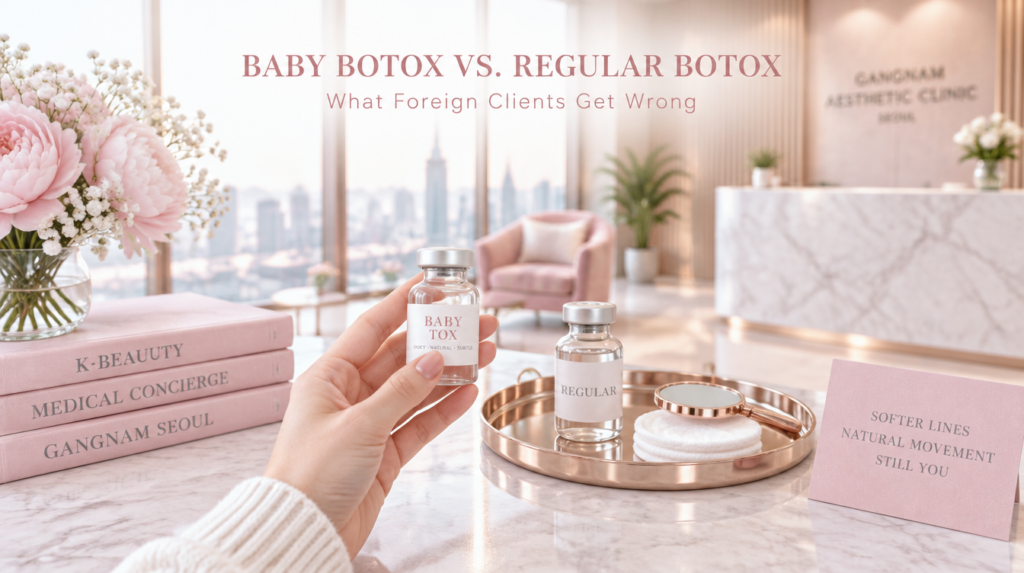
“I just want baby Botox, nothing frozen.” We hear that sentence from foreign clients almost every week. It’s a great goal. The problem is that the phrase means different things in Los Angeles, Dubai and Seoul, and clinics don’t always ask what you mean by it.
Start with the basics: baby Botox isn’t an official medical term. It simply describes using fewer units of a neurotoxin than a standard treatment, for a softer, more natural result (Curology).
So the toxin is the same. What changes is the dose, the placement and how long it lasts. This guide covers what really separates baby Botox from regular Botox, the mix-ups we see most often, and what to confirm before anyone picks up a syringe.
In This Article
Baby Botox vs. Regular Botox: The Real Difference
Both treatments use the same kind of product: botulinum toxin type A, which relaxes the muscles that cause expression lines. Brands include Botox, Dysport and Xeomin, as well as Korean products such as Nabota and Botulax.
The difference comes down to three things.
Dose
Cleveland Clinic gives a useful example. A regular treatment might use about 35 units, while an average baby Botox session uses around 10 units, delivered through small, targeted injections (Cleveland Clinic).
Result
Regular dosing aims to stop the movement that creases the skin. Baby Botox aims to soften it, so you can still raise your eyebrows and smile normally.
How Long Baby Botox Lasts
Smaller doses wear off sooner. Cleveland Clinic notes regular Botox results usually last around three months, while baby Botox lasts around two.
5 Things Foreign Clients Get Wrong About Baby Botox
1. “Baby Botox is a special, milder product.”
It isn’t. Baby Botox uses the same neuromodulators as regular treatment, just in smaller amounts spread across more targeted points (Haute Living).
If a clinic offers a “baby Botox product,” ask which toxin brand it actually is.
2. “Baby Botox and skin Botox are the same thing.”
This is the most common mix-up we see in Seoul.
In Korea, skin Botox usually means many tiny, very diluted injections placed into the skin itself rather than the muscle. Clinics use it mainly for pores, oiliness and fine skin texture. Some Western clinics call this “microtox” or “mesobotox,” and use these names interchangeably with baby Botox (Refinery29).
So if you ask for “baby Botox” for your forehead lines, a Korean clinic may hear “skin Botox” and plan a different treatment. Always describe the result you want, not just the name.
3. “A unit is a unit, whatever the brand.”
Not true. Units from different botulinum toxin products are not interchangeable and can’t be converted with a simple ratio, because each manufacturer measures potency differently (Toxins journal, PMC).
That means “20 units” at one clinic isn’t automatically the same as “20 units” at another. Ask for the brand and the units in writing.
4. “Korean toxin brands are weaker or knock-offs.”
Korea now has a large botulinum toxin industry. Two Korean products also hold US FDA approval: Nabota, sold in the US as Jeuveau since 2019, and Botulax, approved as Letybo in 2024 (Your Health Magazine).
Korean brands are often cheaper per unit, which is one reason prices in Seoul look so low. A Korean brand isn’t a red flag. Not knowing which brand you received is.
5. “Baby Botox is always the better choice.”
It depends on your lines. Baby Botox tends to suit first-timers and people who want to soften early expression lines. Deep, etched wrinkles usually need a traditional dose to make a real difference.
The cost also isn’t always lower over a year. A cheaper session that lasts two months can add up to more than a regular session that lasts three or four.
Baby Botox vs. Regular Botox Quick Reference
| Baby Botox | Regular Botox | |
|---|---|---|
| Typical dose | Lower (e.g. ~10 units in Cleveland Clinic’s example) | Higher (e.g. ~35 units) |
| Goal | Soften movement, natural look | Stop movement that creases skin |
| Best for | First-timers, early fine lines | Deeper, established lines |
| How long it lasts | Around 2 months | Around 3 months |
| Product | Same toxin brands | Same toxin brands |
| Not the same as | Skin Botox (injected into the skin) | Skin Botox |
Guardian’s Insider Note
When a client says “baby Botox,” I never translate those two words to the clinic. I translate what they actually want.
I ask them to show me, in the mirror, which expression they want to keep. Then I pass that to the doctor in Korean: “She wants to keep her eyebrow lift but soften the forehead lines.” That one sentence prevents most of the “I can’t move my face” messages I’d otherwise get a week later.
Timing Your Baby Botox Around a Seoul Trip
Toxin results don’t appear right away. Effects often start within a few days, and results are usually reviewed after about two weeks, when a doctor can add a few units if needed.
That creates a problem for short trips. If you get injected the day before your flight, you’ll never see your result in the clinic.
We suggest booking toxin early in your stay, and if possible a short review visit before you leave. If you’re also planning surgery, ask your surgeon how to schedule toxin around it.
How We Check Your Toxin Treatment Before You Book
As a registered medical tourism facilitator, not a doctor, we don’t decide your dose. Our job is to make sure what’s quoted is what you get:
- Translate your goal into a clear request for the doctor, not just a trend name.
- Ask the clinic to confirm in writing whether it’s muscle toxin or skin Botox.
- Confirm the brand and the number of units on the quote.
- Check that the treatment is performed by a licensed doctor.
- Ask about the touch-up policy if you need a few more units at your review visit.
Comparing quotes? Our guide to Gangnam clinic price traps explains how two-tier pricing works and what an itemized quote should include.
Frequently Asked Questions
Is baby Botox different from regular Botox? It’s the same toxin in a smaller dose, placed to soften movement rather than stop it.
How long does baby Botox last? Usually around two months, compared with around three months for a standard dose, though this varies by person.
Is skin Botox the same as baby Botox? In Korea, usually not. Skin Botox is injected into the skin for pores, oil and texture, while baby Botox treats the muscles behind expression lines.
Why are Botox prices so low in Korea? Korea has many domestic toxin manufacturers, and Korean brands are often cheaper per unit. Always confirm which brand you’re getting.
Can I compare units between clinics? Only if they use the same brand. Units from different toxin products aren’t interchangeable.
Is baby Botox good for deep wrinkles? Usually not. Deep, established lines often need a traditional dose.
Plan Your Consultation
Start here: Message us with the expression lines you want to soften and your travel dates.
What you get: A short online questionnaire, an initial opinion, and a written quote with the brand and units listed before you decide.
How to reach us: Message us on WhatsApp for a personalized plan, or DM us directly. We support English, Arabic and Japanese.
What happens in Seoul: We go with you to the clinic, interpret your goals for the doctor, and help schedule a review before you fly home.
Disclaimer: We are an officially registered medical tourism agency in Seoul, South Korea. Medical consultations and procedures are exclusively conducted by board-certified Korean doctors at accredited clinics. Individual outcomes and downtime vary.
Sources
- Cleveland Clinic — Baby Botox
- Curology — Everything We Know About Baby Botox
- Haute Living — Baby Botox: Why the “Frozen Face” Era Is Over
- Refinery29 — Micro-Botox Injectable Trend
- Toxins (PMC) — Update on Non-Interchangeability of Botulinum Neurotoxin Products
- Your Health Magazine — Overview of Korean Botox Brands
 Instagram
 WhatsApp
 Confidential Consultation Intake Form