How I Verify a Surgeon Is Board-Certified (Not Just “Famous”)
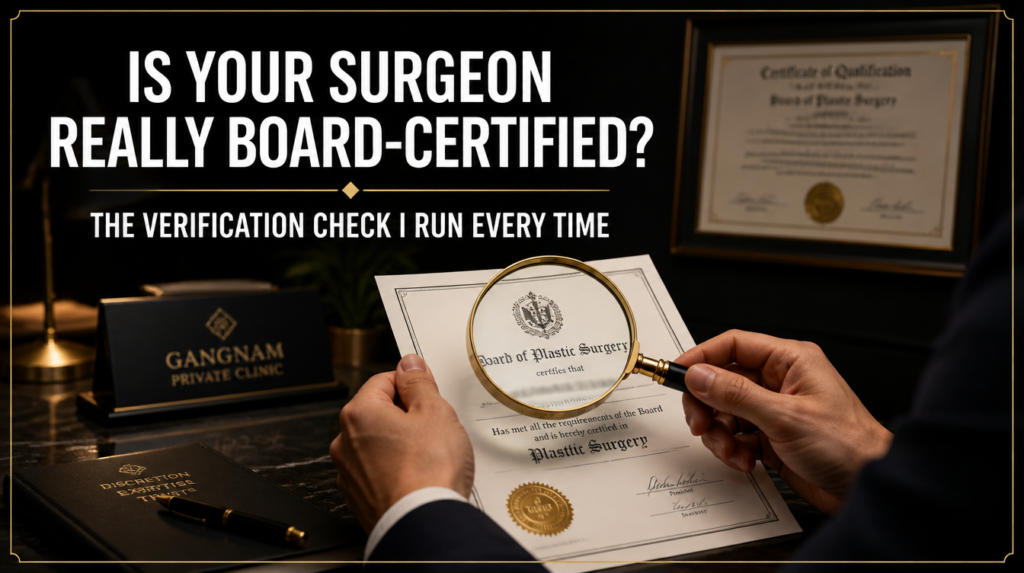
A surgeon can have a million followers, a media-friendly clinic, and a name that comes up in every “best of Gangnam” list — and still not be board-certified in plastic surgery. That’s not a rare loophole. It’s how Korean medical law is actually written. Before I bring any client into a consultation room, I run the same verification check every time, and this article walks through exactly what it is, so you can run it yourself even if you never work with an agency at all.
Why “Famous” Doesn’t Mean Board-Certified in Korea
Here’s the fact that surprises most foreign patients: in Korea, any licensed medical doctor — a dermatologist, an ENT specialist, even a general practitioner — is legally permitted to perform many cosmetic procedures, including surgical ones like rhinoplasty. Holding a Korean medical license is not the same as holding board certification in plastic surgery (issued after a dedicated residency and specialty board exam). A doctor can be completely legal, fully licensed, and still have no formal plastic surgery specialty training.
This is exactly why marketing presence is a misleading signal. A large following, slick before/after content, or media appearances tell you a clinic invests in marketing — they tell you nothing about whether the person performing your procedure passed a plastic surgery specialty board. The only way to know is to check the certification directly, not the marketing around it.
The Official Way to Verify a Board-Certified Plastic Surgeon
The Korean Society of Plastic and Reconstructive Surgeons (KSPRS) — the official professional body for board-certified plastic surgeons in Korea — maintains a public specialist search on its own website, listing several thousand board-certified members nationwide. You search by region and hospital name, and a legitimate result shows the hospital name and the certified specialist’s name directly from the association’s own records, not from the clinic’s own marketing.
The practical takeaway: if a surgeon’s name doesn’t come up in that search under the clinic where they claim to practice, that is a direct, checkable red flag — not a matter of interpretation. It costs nothing, takes about two minutes, and doesn’t require Korean fluency to attempt (though a Korean-speaking coordinator makes it faster and can double-check phonetic name variations).
Guardian’s Insider Note
I’ll be direct about this: I check this registry on every single surgeon before I let a client sit down for a consultation — not after they’ve already paid a deposit. If you’re doing your own research and want a second pair of eyes, send me the surgeon’s name and the clinic on WhatsApp and I’ll check it against the official registry myself, at no cost and with no obligation to book anything. It takes me a few minutes, and it’s the single fastest way to know whether you’re dealing with a specialist or a marketing budget.
The Other Risk Fame Can Hide: Ghost Surgery
There’s a second, more serious verification issue that board certification alone doesn’t solve: making sure the surgeon you actually meet is the one who performs your procedure. Korea’s plastic surgery industry has a well-documented history of so-called “ghost surgery” — cases where a patient consults with a well-known surgeon, but a different, often far less experienced person performs part or all of the actual operation without the patient’s knowledge or consent.
The problem became serious enough that in 2021, South Korea passed a law requiring operating rooms to install CCTV cameras specifically to address it, and patients gained the right to request footage of their own procedure under defined conditions. The existence of that law is itself confirmation of how real the pattern was — legislation like this doesn’t get passed over a hypothetical risk.
What this means practically: verifying board certification tells you the surgeon is qualified. It doesn’t by itself confirm that surgeon is the one who will be in the room. Ask the clinic directly, in writing, whether the surgeon you consult with is the surgeon who will perform the entire procedure, and whether the operating room is equipped with the legally required CCTV.
A Second Layer: Is the Clinic Even Registered to Treat Foreign Patients?
Board certification is about the doctor. There’s a separate, clinic-level check that matters specifically for international patients: whether the clinic itself is officially registered with the Korean government as a “foreign patient-attracting institution”. This registration, tracked through Medical Korea — the government portal operated by the Korea Health Industry Development Institute (KHIDI) under the Ministry of Health and Welfare — exists specifically to oversee clinics that market to and treat international patients.
A clinic can employ a board-certified surgeon and still not be properly registered for foreign patient care, which matters for accountability if something goes wrong during your trip. Checking both — the surgeon’s specialty certification and the clinic’s foreign-patient registration — is the complete picture, not either one alone.
Two-Layer Verification Checklist
| Layer | What To Check | Where |
|---|---|---|
| Doctor — general license | Confirm the doctor holds a valid Korean medical license | Ministry of Health and Welfare license verification service |
| Doctor — specialty board certification | Confirm board certification in the relevant specialty (e.g., plastic surgery) | Korean Society of Plastic and Reconstructive Surgeons (KSPRS) specialist search |
| Doctor — identity in the operating room | Get written confirmation the consulting surgeon performs the full procedure, and that the OR has legally required CCTV | Directly from the clinic, in writing |
| Clinic — foreign patient registration | Confirm the clinic is officially registered to treat international patients | Medical Korea (KHIDI / Ministry of Health and Welfare) |
Frequently Asked Questions
Can a doctor legally perform plastic surgery in Korea without being board-certified?
Yes. Korean law permits any licensed medical doctor to perform many cosmetic procedures regardless of their specialty. Board certification in plastic surgery is a separate, additional credential — not a legal requirement to perform every cosmetic procedure — which is exactly why checking it directly matters.
How do I check if a Korean surgeon is board-certified?
Search the surgeon’s name and clinic in the Korean Society of Plastic and Reconstructive Surgeons’ public specialist directory. If they don’t appear under the clinic where they claim to practice, treat that as a direct red flag and ask the clinic to explain the discrepancy in writing.
What is “ghost surgery” and how do I protect myself from it?
Ghost surgery refers to cases where a different, often less qualified person performs some or all of a procedure instead of the surgeon the patient consulted with. Ask the clinic in writing whether the consulting surgeon performs the entire procedure and whether the operating room has the CCTV required by Korean law since 2021.
Does a famous or highly followed clinic mean the surgeon is safe?
No. Marketing reach and social media following reflect investment in promotion, not medical qualification. They should never substitute for directly checking board certification and clinic registration.
Book a Protected Consultation
Considering a procedure in Seoul and want someone to check the surgeon’s certification and the clinic’s registration before you commit to anything? Send the surgeon’s name and clinic to WhatsApp — verification is free, comes with no obligation to book, and takes a few minutes on my end. If everything checks out, we can talk about next steps; if it doesn’t, you’ll know before you’ve spent a dollar.
WhatsApp Verification Request · Inquiry Form

Disclaimer
We are an officially registered medical tourism agency in Seoul, South Korea. Medical consultations and procedures are exclusively conducted by board-certified Korean doctors at accredited clinics. Individual outcomes and downtime vary. Verification steps described in this article reflect publicly available registries and reporting as of the time of writing; always confirm current details directly with the relevant Korean authority or association before booking.
Sources:
- CNN — “In South Korea, patients pay for a star plastic surgeon – and get operated by a ghost doctor”
- Library of Congress — “South Korea: Video Cameras to Be Installed in Operating Rooms”
- The Korea Times — “Patients, doctors at loggerheads as operating room CCTV footage made mandatory”
- Korean Society of Plastic and Reconstructive Surgeons — Specialist Search
- Medical Korea (KHIDI) — Foreign Patient Portal


